

GABON PARTICIPATES IN THE 2ND MEETING OF THE AFI REGION AVIATION SYSTEM PLANNING AND IMPLEMENTATION GROUP IN AFRICA AND THE INDIAN OCEAN
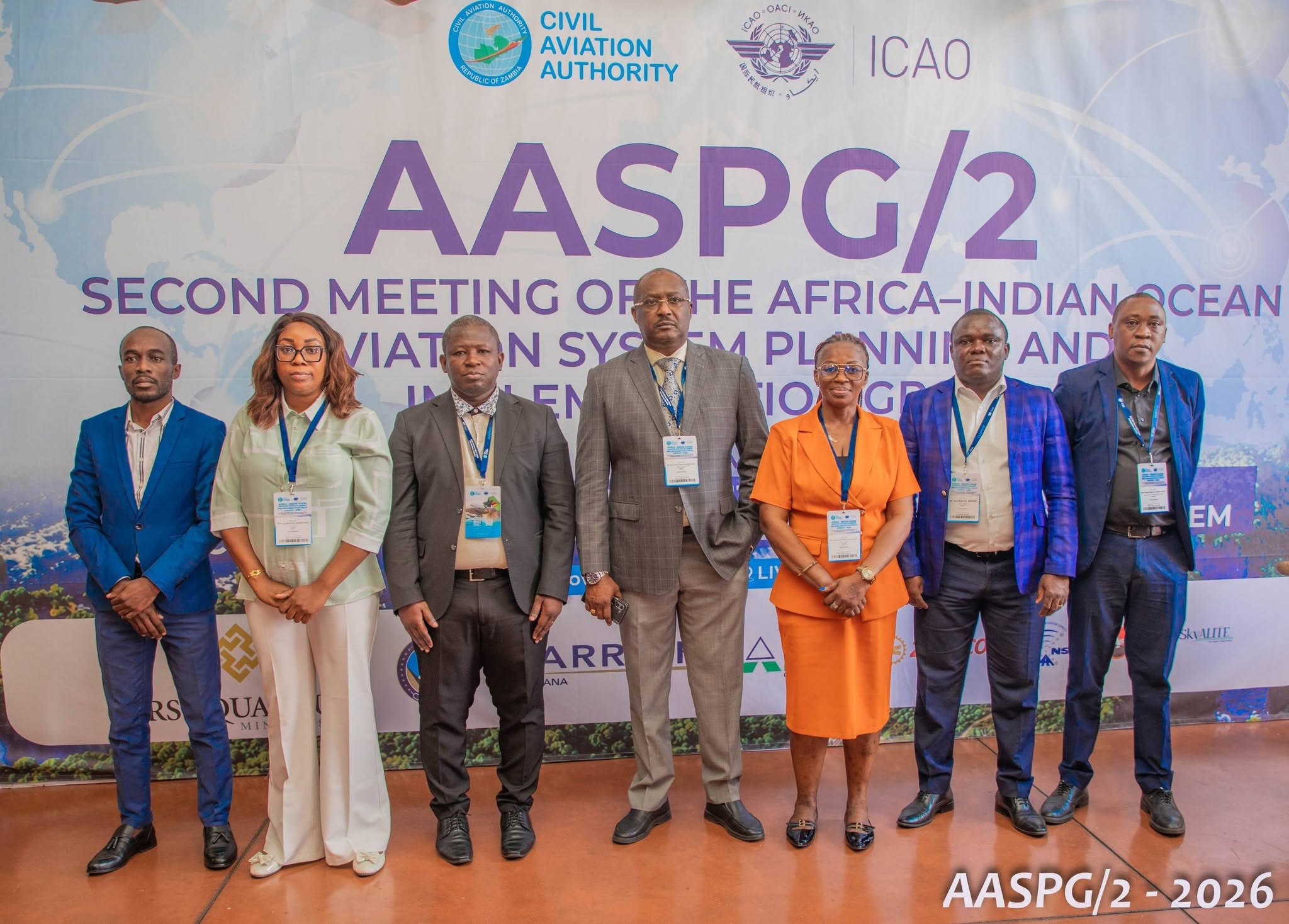
The city of Livingstone, Zambia, hosted from November 2 to 6, 2026, the second meeting of the Africa-Indian Ocean Aviation System Planning and Implementation Group (AASPG/2), organized under the auspices of the International Civil Aviation Organization (ICAO). Held under the theme “From Planning to Implementation: Promoting a Safe, Efficient, Connected, and Sustainable AFI Aviation System,” this regional gathering brought together over 300 participants from States, ICAO regional offices, international and regional organizations, the aviation industry, and other sector partners.
Following the inaugural event in Libreville, the main objective of this second meeting was to assess progress in implementing the conclusions and decisions from AASPG/1, while identifying priority actions required to enhance the performance of the civil aviation system across the Africa-Indian Ocean region.
Specifically, the meeting aimed to strengthen aviation safety, optimize air navigation capacity, modernize infrastructure and equipment, consolidate inter-State cooperation, and foster the harmonized application of ICAO Standards and Recommended Practices (SARPs). The ultimate goal is to transition from strategic guidelines and regional commitments to concrete, coordinated, and measurable actions.
Gabon, through its National Civil Aviation Authority (ANAC), actively participated in the meeting with a delegation led by Major General Éric Tristan Franck MOUSSAVOU, Director General of ANAC.
The delegation comprised:
-
Major General Éric Tristan Franck MOUSSAVOU, Director General of ANAC;
-
Ms. Laeticia Paule DIECK, Director of Air Navigation;
-
Mr. Leonel MBA NKILI, Head of MET/SAR Service;
-
Mr. Yvan Marvel ILOKI, CNS Inspector;
-
Ms. Else Laurianne MANGUENDJI, PNS Inspector;
-
Mr. Joe Mannix LEKIBI, AGA Inspector;
-
Mr. Dan MANFOUMBI, Head of AIS-MAP Service and AIM/MAP Inspector.
The opening ceremony featured the national anthem, a prayer, and three official addresses. Opening remarks were delivered successively by Ms. Lucy Mbugua, Regional Director of the ICAO Eastern and Southern African (ESAF) Office; Ms. Paule Koki, AASPG Chairperson and Director General of the Cameroon Civil Aviation Authority (CCAA); and Ms. Gabriel Chileshe Kunda, Board Chairperson of the Zambia Civil Aviation Authority, who delivered the welcome address to the visiting delegations.
These speeches underscored the necessity of continuous consultation between States and aviation industry stakeholders to address shared challenges, pool expertise, and build regional capacity. They also reiterated the importance of a coordinated approach to building an air transport system that meets international standards for safety, efficiency, and sustainability.
During the technical sessions on November 3, 2026, Gabon presented national progress achieved in developing a national space weather guidance manual. Presented by Mr. Leonel MBA NKILI, Head of the MET/SAR Service, the briefing highlighted Gabon’s experience in implementing ICAO guidance in this domain.
Based on ICAO Doc 10100, this initiative aims to provide air navigation service providers, operators, and meteorological services with a reference framework to facilitate the use of space weather advisory information. It thus supports the harmonized implementation of PANS-MET provisions and serves as a model that can be replicated by other States within the AFI region.
Through this contribution, Gabon reaffirmed its commitment to actively sharing knowledge and best practices while contributing to the continuous improvement of air navigation services.
Over the five days of deliberations, participants reviewed nine agenda items covering several strategic areas of air transport.
Regarding aviation safety, the meeting approved the new 2026–2028 edition of the Regional Aviation Safety Plan (AFI-RASP). States were also encouraged to develop or update their National Aviation Safety Plans in alignment with the Global Aviation Safety Plan (GASP).
Discussions also addressed National Air Navigation Plans, the transition to RNAV 5 navigation systems, the enhancement of altimetry surveillance, and capacity building for instrument flight procedure oversight.
Special focus was placed on regional Search and Rescue (SAR) cooperation, aerodrome certification, the modernization of communication and navigation systems, as well as the sharing of human resources, technical capabilities, and expertise among States.
On the sidelines of regional discussions, issues regarding the compliance of Gabonese airport infrastructure were also addressed. In this regard, certifying Port-Gentil and Mvengué airports remains a top priority for ANAC.
Recognizing the technical, operational, and regulatory demands of this process, the Director General of ANAC requested support from ICAO. Consequently, ICAO committed to supporting Gabon in this endeavor, notably through its Western and Central African (WACAF) Regional Office, to assist with the actions required for the certification of these two airport platforms.
This commitment represents significant support for Gabon in achieving this strategic goal, which contributes to enhancing airport safety and improving infrastructure compliance with international standards.
The technical sub-groups formulated several draft decisions and conclusions covering airspace and aerodrome operations, infrastructure, aeronautical information management, and safety oversight.
At the conclusion of the meeting, fifty resolutions were adopted. These reflect the collective determination of States and partners to advance the civil aviation system in the Africa-Indian Ocean region by shifting focus toward concrete and measurable implementation of commitments.
These resolutions revolve primarily around three core pillars: technological modernization of aeronautical systems, safety enhancement, and regional cooperation.
However, participants also highlighted several persistent challenges, including gaps in safety standard implementation, aerodrome certification hurdles, shortages of qualified inspectors, infrastructure deficits, and insufficient Search and Rescue cooperation.
These findings emphasize the need for States to strengthen monitoring mechanisms, improve data sharing, and mobilize additional human, technical, and financial resources to ensure the effective implementation of recommendations.
For Gabon, the outcomes of this second meeting provide an important guiding framework to sustain ongoing efforts toward international compliance and continuous improvement of its civil aviation system.
Key next steps include appointing focal points, aligning national safety and air navigation plans with regional directives, and actively participating in new cooperation mechanisms.
Ultimately, Gabon’s participation in AASPG/2 provided an invaluable opportunity to share its experience, stay abreast of new regional directives, and advocate for its strategic priorities before competent international bodies.
For ANAC-Gabon, this event reaffirms its commitment to regional and international initiatives and its determination to work alongside partners to build an increasingly safe, efficient, integrated, and sustainable civil aviation system.
Source : ANAC-Gabon