
Côte d’Ivoire–Emirates: Abidjan bets on air connectivity to accelerate its tourism strategy
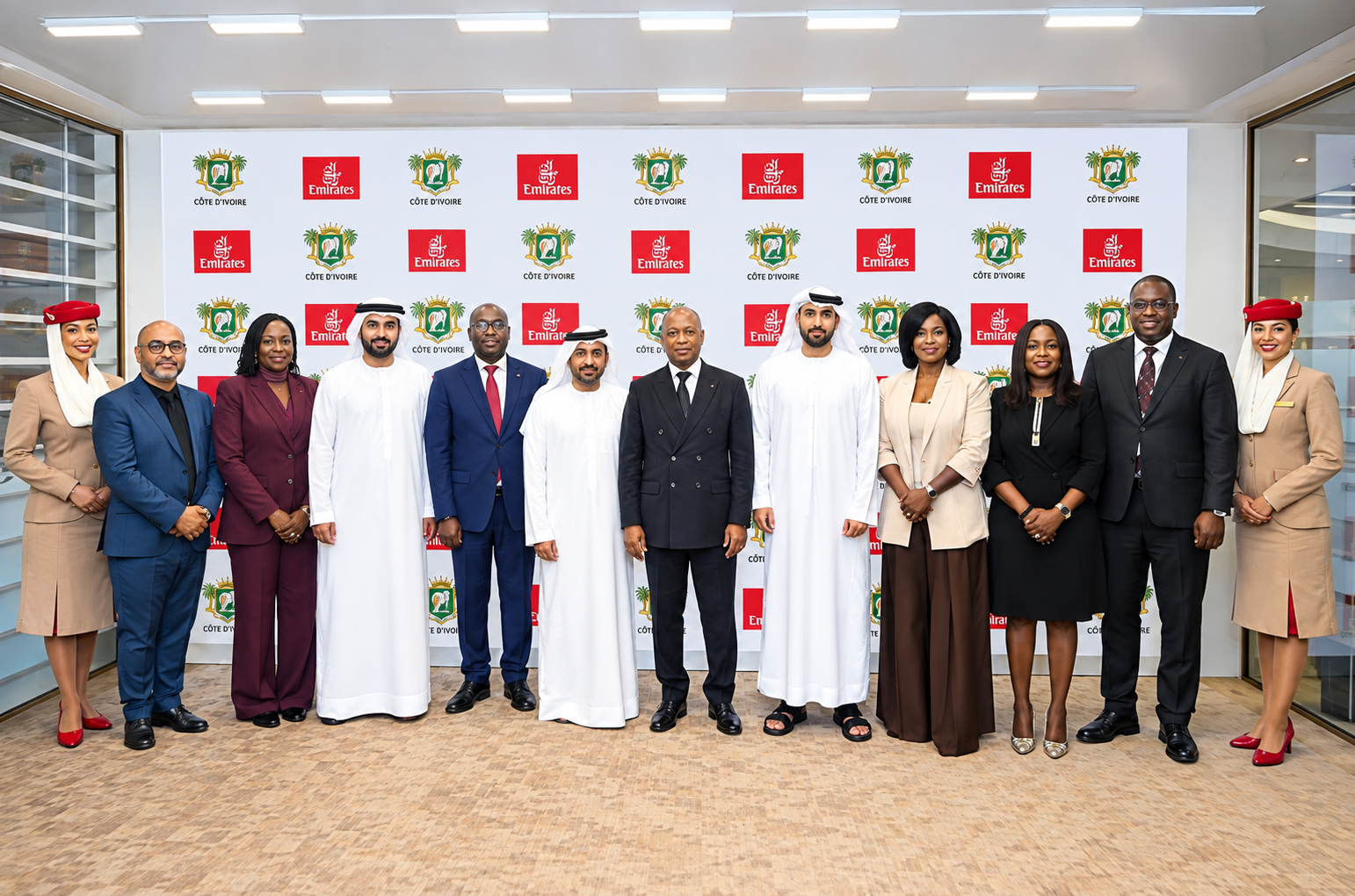
Côte d’Ivoire and Emirates signed a memorandum of understanding in Dubai on 14 September 2026, aimed at strengthening air connectivity and destination marketing at the same time. Beyond tourism promotion, the initiative seeks to convert Emirates’ international network more effectively into visitor and business traffic to Abidjan. For Côte d’Ivoire, the stakes also include consolidating Félix-Houphouët-Boigny Airport’s position within the West African air transport system.
An agreement linking aviation and tourism strategy
The memorandum, signed between Côte d’Ivoire’s transport and tourism ministries and Emirates, rests on several levers: joint promotional campaigns, data sharing, familiarisation trips for industry professionals, commercial terms designed for tour operators, and the carriage of promotional materials.
This approach reflects a shift in the role airlines play in tourism policy. For a destination like Côte d’Ivoire, having air capacity is not enough: that capacity must also be turned into tourism demand, business travel and local spending.
The agreement was concluded during Arabian Travel Market 2026, where Emirates signed several partnerships with tourism bodies in order to use its international network to raise destination visibility and drive visitor flows.
Emirates, a gateway to the Dubai network
For Abidjan, the strategic appeal lies largely in access to Emirates’ extensive international network through its Dubai hub.
The relationship between Emirates and Côte d’Ivoire dates back to 2006, when the airline launched its Abidjan service via Accra. Even then, the route was presented as a way of opening up markets in the Middle East, Europe and Asia to Ivorian businesses.
The model remains relevant for trade: new international connections can ease business travel, but also give Ivorian companies access to foreign markets.
The Dubai platform is particularly important in this equation. Emirates today serves a network of close to 140 destinations and continues to expand its presence in Africa and across international markets.
Abidjan wants to strengthen its role as a regional hub
For the Ivorian authorities, the agreement is part of a broader ambition: to make Félix-Houphouët-Boigny International Airport a major gateway to West Africa.
That ambition, however, requires more than higher passenger numbers. It implies continuous improvement across the airport chain: passenger processing, security, customs, immigration, ground services, infrastructure capacity and coordination between the various stakeholders.
The Ivorian transport ministry indeed plans to facilitate coordination between the civil aviation authorities, airport infrastructure operators and security and customs services in order to support the growth of Emirates’ activities.
The challenge is therefore twofold: increasing Abidjan’s international connectivity while improving the platform’s ability to redistribute traffic across the sub-region.
Economic potential that goes beyond tourism
The expected impact is not limited to tourist arrivals.
Better international connectivity can support several segments of the economy: business travel, conferences and events, foreign investment, international trade, hotels, restaurants and air-transport-related services.
Emirates’ track record in West Africa illustrates this dimension. During its expansion in Accra, the airline had already highlighted the role of its route in trade and tourism flows. In 2026, Emirates added four weekly frequencies between Dubai and Accra, taking its programme to 11 weekly flights on that route.
For Abidjan, the question will be how far closer cooperation with Emirates can generate additional flows that are genuinely captured by the Ivorian economy, rather than simply increasing air transit.
Côte d’Ivoire is aiming for a step change in tourism
The strategy fits the government’s stated goal of increasing tourism’s weight in the national economy and raising the destination’s international profile.
According to figures released by the Ivorian authorities, the country welcomed around 6.7 million visitors in 2025, generating more than 1,100 billion CFA francs in tourism receipts. These figures have also prompted public debate over their methodology and scope, underlining the need to improve the sector’s statistical tools.
The stated objective is now to join the top five African tourist destinations by 2030.
Achieving that will make air connectivity a decisive factor, but it will need to be matched by sufficient accommodation capacity, a diversified tourism offer and an effective strategy for converting visitors into local economic benefits.
A test for Abidjan’s hub strategy
For air transport stakeholders, the memorandum is above all an indicator of how Abidjan intends to align aviation policy, tourism and economic development.
The real challenge will now be operational: capacity growth, connection quality, fare competitiveness, growth in tourist and business traffic, and the airport’s ability to absorb that growth.
The presence of an international carrier such as Emirates can help widen the market accessible from Abidjan. But consolidating a regional hub will also depend on Côte d’Ivoire’s ability to develop its own aviation ecosystem and improve links with other West African markets.
Outlook: turning connectivity into economic value
The Côte d’Ivoire–Emirates agreement thus opens a new chapter in the development strategy for the Ivorian destination. The challenge will not only be attracting more passengers, but turning international connectivity into lasting value for the national economy.
In the medium term, frequency growth, Abidjan’s capacity to handle more traffic and the effectiveness of promotional schemes will show the partnership’s real reach. For investors and operators in the sector, the trajectory of Abidjan’s international traffic will also be an indicator to watch when assessing opportunities in hotels, airport services, business tourism and logistics.
Across West Africa, the central question remains: will Abidjan manage to turn stronger connectivity into a genuine regional hub advantage?