
Air Corridor in Africa: Definition, Role, and Functioning
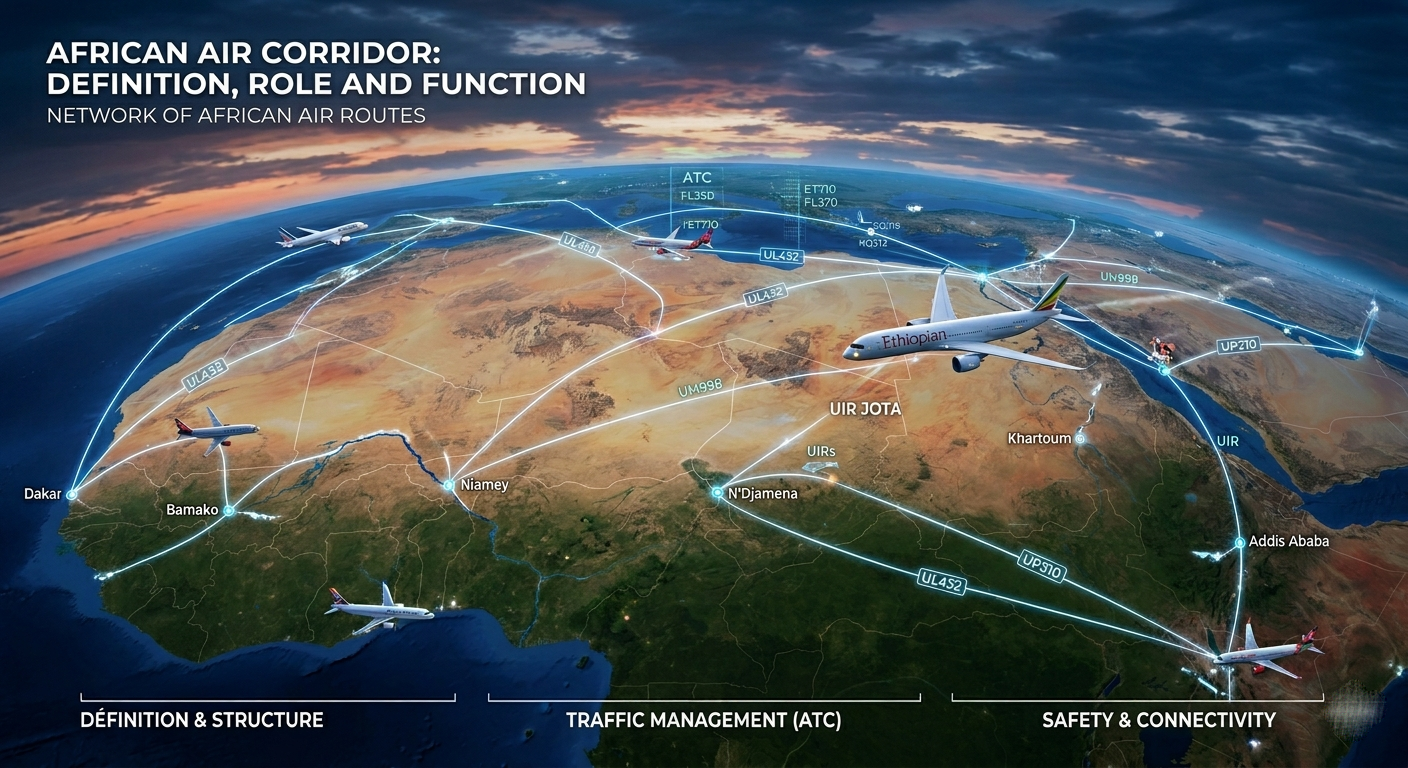
An air corridor is a fundamental element in the organization of global air traffic. Invisible to passengers but crucial for pilots and air traffic controllers, it structures the flow of aircraft in the sky. In Africa, where air traffic is rapidly growing, air corridors are essential for flight safety, route optimization, connectivity improvement, and traffic management at regional hubs. Understanding this concept helps grasp how modern aviation operates on the continent.
What is an Air Corridor?
An air corridor is a three-dimensional flight route that aircraft follow under strict rules.
Structure:
- Width: approximately 19 kilometers (10 nautical miles)
- Vertical limits: precise altitudes to separate aircraft
- Navigation points:
- Ground-based navigation aids (VOR, NDB, TACAN)
- Intersections of radials from multiple beacons
- GPS coordinates for modern satellite-based navigation
Safety:
- Separation from ground obstacles: 1,000 feet in plains, 2,000 feet in mountainous areas
- Managed by air traffic controllers to avoid collisions
Function:
- Structure air traffic
- Allow radar monitoring and traffic management
- Serve as backup routes in case of radio communication failure
Alternative:
- In restricted zones (conflict or military areas), specific corridors can be opened to maintain minimal flight operations safely
Why Are Air Corridors Essential?
- Safety
Air corridors ensure that each aircraft remains horizontally and vertically separated from other planes and ground obstacles. Air traffic controllers continuously adjust aircraft trajectories to prevent any risk.
- Traffic Flow
They enable orderly traffic movement, especially in high-density airspace, as seen in Africa.
- Route Optimization
Air corridors help:
- Reduce flight times
- Save fuel
- Limit emissions
- Monitoring and Redundancy
In case of radio failure or navigation issues, air corridors serve as backup routes, ensuring flight continuity.
How Do Air Corridors Work?
- Route Definition and Navigation
An air corridor is a three-dimensional path aircraft follow from one point to another. Navigation points can be:
- Ground-based beacons transmitting on specific frequencies (VOR, NDB, TACAN)
- Intersections of radials from multiple beacons
- GPS coordinates for modern navigation
- Air Traffic Control
Aircraft are monitored by air traffic controllers, who ensure:
- Horizontal and vertical separation
- Safe distance from ground obstacles
- Radio communication on dedicated aviation frequencies
On the ground, controllers guide planes like road traffic. In the air, they adjust flight paths to avoid collisions.
- Managing Congestion
During high traffic or poor weather:
- Aircraft enter holding patterns
- Each plane maintains a specific altitude until the runway is clear
- During final approach, spacing can be reduced to just 3 nautical miles
- Communication
- Controllers communicate exclusively in English, the international aviation language
- Teams rotate every two hours to maintain high safety and decision-making standards
African Example
At Blaise Diagne International Airport, flights to Europe follow well-defined air corridors over the Atlantic. These routes allow:
- Efficient international traffic management
- Safe intercontinental flights
- Connectivity between Dakar and European hubs
Similarly, the hub at Addis Ababa organizes a complex network of corridors connecting Africa to Asia and the Middle East, facilitating radar monitoring and managing flight connections.
Challenges and Opportunities in Africa
- Airspace modernization: improving navigation systems and radar coverage
- Regional coordination: fragmented airspace between states makes route harmonization challenging
- Traffic growth: increasing flight numbers require better corridor management
- Strategic opportunity: reduce airline costs, improve punctuality, and strengthen African hubs
FAQ – Air Corridor
Q1: What is an air corridor?
It is a three-dimensional flight path that planes follow for safe travel.
Q2: Can an aircraft leave an air corridor?
Yes, but only with air traffic control authorization.
Q3: Who defines air corridors?
Civil aviation authorities in coordination with international organizations.
Q4: Why don’t planes fly in a straight line?
To maintain safety, avoid traffic, and facilitate radar navigation.
Q5: Do air corridors change?
Yes, depending on weather, traffic, or infrastructure changes.
Key Takeaways
- Air corridors are three-dimensional flight routes, 19 km wide with precise vertical limits
- They ensure flight safety, traffic flow, and route optimization
- They are critical for managing traffic in African hubs
- Air traffic controllers monitor compliance and aircraft spacing
- Corridors can also serve as backup routes or specific paths in risk zones